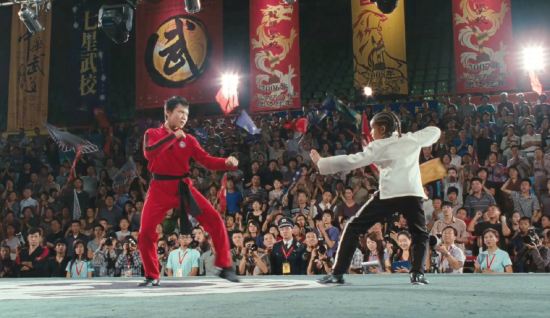
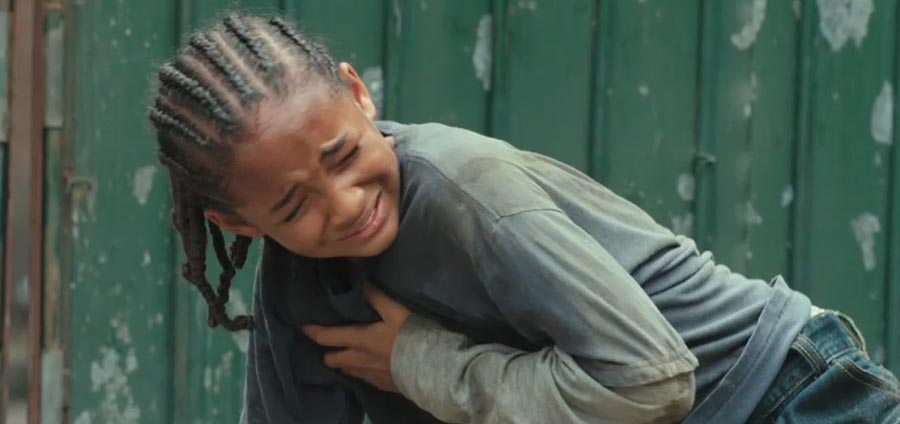
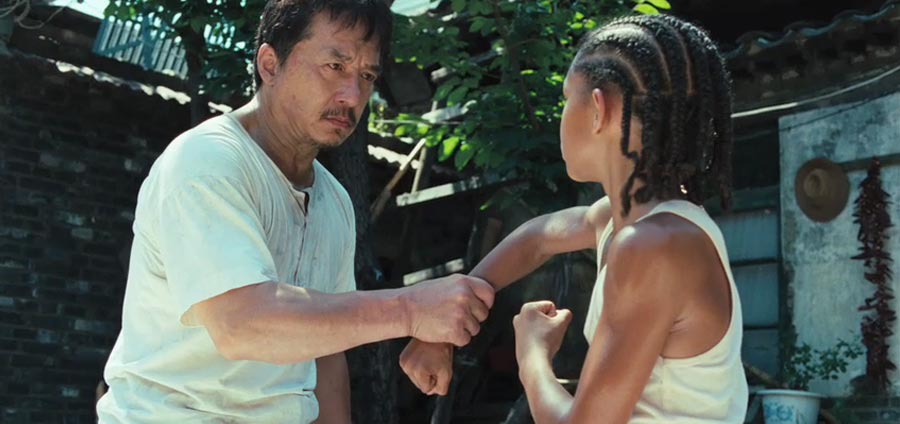
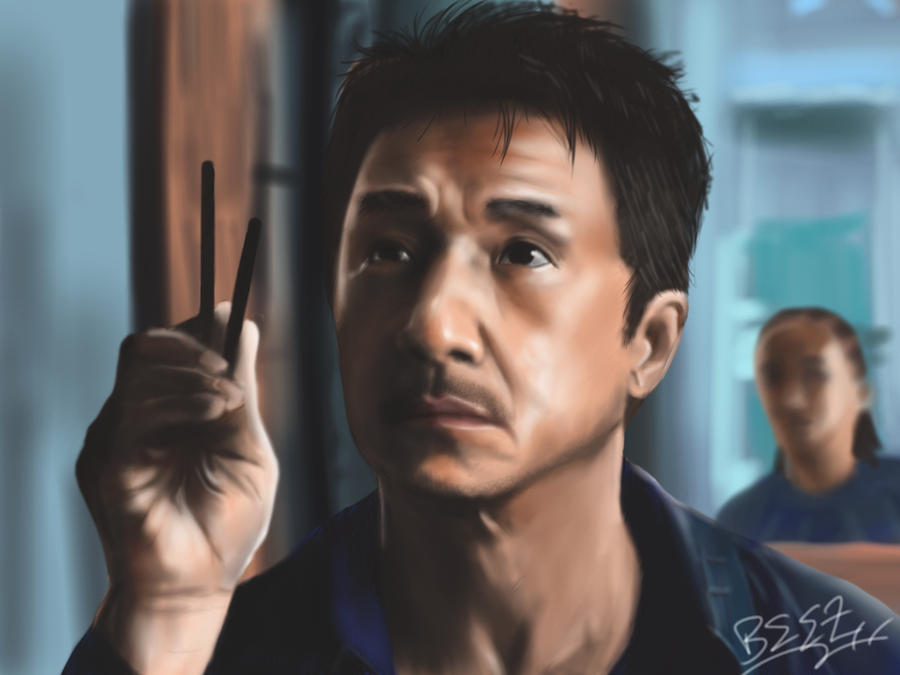
A small collection of screenshots from the AOG movies, Little Big Soldier and The Karate Kid. To save the HD copy just right click on the image and save.


The Karate Kid 2
Going wildly against expectations, the 2010 remake of The Karate Kid actually turned out to be a pretty decent, if rather long movie.
Jackie Chan and Jaden Smith will thus be returning for a follow-up, with director Harald Zwart looking to do a different story, rather than remake one of the earlier sequels.
We won’t get the film until 2013, and the last we heard was that the writers of Kung Fu Panda, Cyrus Voris and Ethan Reiff, had been tapped to pen the script.

Dead in the WaterSOURCE:
Back in March, I made a rather ballsy and foolish claim that the remake of The Karate Kid would be nominated for a number of Oscars after seeing it at ShoWest. As much as I love the movie, that's doubtful at this point, especially with Sony putting more behind Fincher's The Social Network to win. I'd still like to see Jackie Chan get a Supporting Actor nomination, because I think his performance is fantastic, but Sony isn't bothering to push the movie, not even including it in with their awards screenings, so it's a bit of a lost cause.

I'd love to start at the top and ask how you got onto this project and how your career has progressed to this point?
Harald Zwart: Well, I had already done a movie for Sony so they knew me. And so it was kind of easy for me to get in the mix. But then once I was in the mix, there was a bunch of other people who were really wanting to do this project. And I got further and further up the food chain, meeting after meeting after meeting. And I felt that I knew exactly how I wanted to do the movie - I kind of wanted to treat it a little like an independent movie. I wanted to give the movie the flavor that independent European movies have. I'm from Europe and so I tried to really emphasize on what the emotional side was going to be in my version. I also tried to bring in the Shadow Theater and elements of China that you don't normally see. And I got further and further up and then eventually it was me and one other guy and I could not kick him out of the competition. So what I did was I - my wife and I just said - what do we do now, because he was a guy who had done a lot of these movies. He's a very talented director. And we decided to build a scale model of Jackie Chan's house [in the movie]. I could send you pictures if you want.
Sure.
Zwart: And we went into this model train store and bought sheets of roof tiles and then we spent three days after the kids had gone to bed and built his whole courtyard. It's about this big. We put little dummies and she came up with that utility pole in the middle, and then I started playing with the flashlight and I discovered that oh, they can actually become the Shadow Theater, with the lights from the car, and we lit it with little lamps. And that's how I walked into - Amy Pascal['s office], who is the head of Sony - a really smart woman and she responds to… I mean she just likes it when you show stuff like that. The passion and she understands the texture of things. And so once that thing was on the table, I think I won the competition [right] then. I don't know [if it was] that thing alone, but it was just something extra. At least that's how it looked from my point of view
Right, I know what you're saying. I have so much to ask, so the next topic… From the beginning, was it always the idea to move it to China? To set it there?
Zwart: Yeah, when I came on board, that was already [in] the script, the idea. Jackie was attached and Jaden was attached and Will was producing it with his company. So that was already done.
Did you have any involvement in the writing process once you got attached and on-board?
Zwart: Yeah, I mean, as is natural for a filmmaker, we started with - we were a group with Will and Ken Stovitz, who's a great producer, and the writer, Chris Murphy and then there was a script guru, Michael Hague, who we all have read his book. And we went off to this place up in the mountains, just working for days and days. But when you do a movie with Will Smith, he doesn't bring the book. He brings the guy who wrote the book. So that was amazing for me to sit there… We just sat around in a circle, day and night, just talking through everything, the story. We did a lot of research on the depth and the secrets of kung fu, a lot of research on bullying, inspired by Oprah Winfrey's show. We spoke to some of the people that she had on her show. I love the mythology behind just going into such depth of every character, because then once we - and we had tons of rehearsals. And then so once we went to China, it was just really painting it and making it as beautiful as we could.
It seems interesting that you were attached after Jaden and Jackie Chan were on-board. Because normally, at least from my perspective, I see directors get on-board and then it's them who are choosing the actors for the film. So what was it like coming on with them? I think the end result, obviously, they're perfect for the roles. But it must have been interesting with that dynamic coming on with them on-board and working with them moving forward.
Zwart: Yeah, I mean that happens quite a bit that you get sent a project that some star is already attached to. What that does is, it gives you the - that the likelihood of this actually becoming a movie or getting a greenlit is much greater.
Yeah, of course.
Zwart: So it's a much faster - I just realized today that it's less than a year since we started the process… So it's gone really quick. Whereas if you get a script like you say and you have to find the stars, sometimes it can [take] forever. Besides, I think, both of those guys were absolutely the perfect choice for the movie. That's also partially why I got really excited about it because I [could] just [see] the movie right away.
Was it always the intention from the beginning to pay homage to the original in the sense of its story structure? Because when I saw it, it felt very similar in the sense of the progression and the story. But the characters are different and the location is different. And I could see any number of other possibilities of saying okay, we'll take the Karate Kid's original story just go off with some other idea. But was it always that goal to stay very similar to the original, to pay homage to it as much as you could? Was that always the goal from the beginning and what you tried to do while shooting?
Zwart: Yeah, we all loved the original movie and we know that the original is very close to perfect. It's touched so many hearts. There is nothing wrong with the structure of it. It's just actually really, really good. So we just wanted to really maintain the beats and the points in the movie. But we wanted to do them different. And I think when you see the movie, most people that I hear from, they say they forget after ten minutes that they're watching a remake, even though it is actually very much point to point the same beats. The biggest challenge was obviously those amazing iconic moments, the wax on, wax off, the crane. All those things - how do we top that or at least make it as good? I remember sitting down with Will one breakfast and we were talking you about that fly thing and I thought how would I do this in a commercial? I thought we just need a button to that thing and then we all came up with, what if you think it's gonna be that, that he's going to catch it, and then the fly swatter comes out of nowhere. And that's like signing a contract with the audience saying, we know that you're waiting for these moments and you'll get them. We'll just do them a little differently. Jackie does wax the car in the movie. You can see the crane in the shadow on the wall. So they're all there, every single one of them. We just did them differently.
Are you concerned about the comparisons that are going to be made between the two films in the end when it comes out? Do you feel a lot of that stress?
Zwart: Yeah, it's funny. Like I said, I'm from Europe and the movie was a big hit back there. But it wasn't as enormous as it was here. When I went on the project, I didn't know that this was like messing with a national treasure. I didn't know that. And I might have been more nervous going into it then. So I was like okay, let's just make the best movie possible. And then after a while, when people came surfacing saying, what are they doing messing with this, to me it would have been the same thing as somebody trying to make a remake of Star Wars - I'd be like oh, come on. But I think we've succeeded very well in making it different enough that - because we're retelling a story. We're not necessarily remaking a movie. And it's an epic story about a kid who really needs to stand up for himself and he gets helped by a mentor. I always compared - it's as if Spielberg came to me and said, okay I will spend three months teaching only you how to make movies. I think what works in our favor is Jackie Chan, the idea of having Jackie Chan teach you and only you for months after months, is more than what Mr. Miyagi kind of achieved back then, I think. Because everybody knows him as - oh how cool would that be?
Obviously this comes from China being the location, but kung fu being the new form of martial arts that is the focus of the film. Is that something that from the beginning was the plan and was there ever a possibility that it would have just been karate like previously?
Zwart: No, in going to China, it had to be kung fu. And we just had to figure out how to make people understand that we know China is kung fu and karate is Japan. And we decided to keep the title because when you see the movie, you'll understand that it is a stigma. They are teasing him by calling him the karate kid. That's why it made total sense to us. In the movie, also the mom who doesn't really know the difference, she says, 'didn't you like that karate class?' And he goes, 'it's not karate mom.' So we all know it's kung fu. For me the big difference physically, was that in karate, there is a lot of the mechanical, this and that and you can just rehearse things over an over again. Kung fu is a lot more of a ballet. So when we came up with the jacket on, jacket off thing, there are like twelve moves buried in one single swooping move. And that's what I loved about the whole idea, that you can learn one thing and what you discover is that you've actually learned twelve different kung fu moves within that one little thing.
Who did you work with in China for all the kung fu training?
Zwart: We worked with Wu Gang. He's the master, as they call them, and he is one of Jackie Chan's guys and he himself was a champion in kung fu and wushu, as they call it over there. And he was fantastic. I mean the choreography on the end fights are just amazing.
Yeah - that was one of my favorite parts, just watching him learning kung fu, especially for me. Since I don't know it, instead of just seeing a movie where they're just perfect at it, watching the progression of learning how to do it up to that point and then seeing Jackie Chan's skills and everyone else just coming into it. I thought it was just, as you said, beautiful, and the choreography was great in the end.
Zwart: Well, thank you.
What was it like shooting in China? I imagine that was very interesting.
Zwart: Yeah, I mean, having had a commercial career, I pretty much shot all over the world already. I thought I had never come across any challenges that I wasn't going to - I thought I knew most things, very pretentiously of course. But then in China, it was a whole different aspect, because of the language barrier obviously, which we overcame with translators. And there is also a massive amount - the crew was a 550 man crew.
Wow.
Zwart: I wanted to make this a bit like Slumdog Millionaire, where I went into the streets and the corners of Beijing and shot authentic stuff. So I had to just talk to Jackie and Will and say - because they come with… Jackie - it's Beatlemania when Jackie walks up the street in China. So I had to say, let's jump in a van and you guys put on baseball caps and sunglasses and we'll get ready. When the cameras are rolling, you jump out, and Will was standing behind with me on a small monitor. That was the only way we could actually do it, because as soon as Jackie walked through the shot and they saw that he was there, it was pandemonium. And the same thing when we went to the mountains and those temples. To get there, you have to drive for hours into the mountains and then take a bus and then take a gondola that just takes two people and it goes almost vertical. And I said, I'm dependent on the light. If I'm going to wait up there for a 550 man crew… So we just all - let's do this like an indie movie and Will and Jaden jumped on with lens cases on their lap and Jackie schlepped equipment up. And we just shot it all off the shoulder and that's how it got that whole vibe all the way through the movie, which I'm very happy with.
How has the post-production process been? How has it been coming together for you watching it here and scoring and everything you're doing?
Zwart: I mean, that's always my favorite part. We cut the movie together pretty quickly and had an amazing test screening, which just convinced everybody this movie was maybe bigger than we first thought. And then we were so fortunate to get James Horner who came straight off of Avatar and nobody thought we would get him. But we showed him the movie and he loved it. So the last few days we've been in here, in the old Son scoring stages, and we just added the last touch of James Horner which gives the movie an enormous scope.
I'm looking forward to seeing how well it does and just reception. From what I saw watching it, I think it will be received very well. I think it's got potential to live up to the original and really surprise fans with everything you said in that it's a very different story, but with the same beats and different locations. I think it's a really great feel.
Zwart: Thank you.
With your career so far, you've done mainly family films.
Zwart: Yeah.
And is that sort of your forte? Is that what you love doing? Would you love to branch off in different genres and do other kind of films?
Zwart: Yeah. I think that's always a tough question. You always have these discussions with your team, the agents, and what's a good career move. And like I said, I've never really considered myself as very specific genre this or genre that. And commercials have taken me all over the gamut in terms of genres. So if you put the career thinking hat on, you go, oh family movies. That would make a lot of money. But you know, as a filmmaker, I think I've shown, at least with Karate Kid, that the visual side and that there's a much more - I think that goes for any director - that there's a lot more in every filmmaker than what you pigeonholed him to [initially]. But I would definitely love to get into more - I love science fiction. If I could make like a really serious Alien type movie, I would love that.
I also like the Indiana Jones franchise, with adventure but still serious and scary for kids. I wish I could just give you a clear answer, but frankly I really don't know.
Well, I mean it's essentially a hypothetical question, as in like what would you love to do?
Zwart: It's like I said, if the story intrigues you, the genre comes second, I think.
Yeah, interesting. That reminded me about shooting in China on locations and obviously the result in this is so visceral, so unique. But we see so often nowadays the trend of shooting in studio, shooting with green screens. Moving forward in your career, are you going to strive to shoot on location as much as you can? I mean, you said before that you've shot around the world. It seems like you really like doing that?
Zwart: Yeah. I think the authenticity of things… We decided on this movie also - no green screen, no effects, nothing. We want to go there and be on those locations. And it does give the movie a different breath, I think. There are still limitations, I think, in what you can achieve on green screen and the suspension of disbelief is always limited when people smell that they've been manipulated. It, again, depends on the story. But I always try to do as much in camera as I possibly can.
Is there anything else that you are currently attached to or working on besides The Karate Kid?
Zwart: Yeah, I have a few things. They're not announced yet, so I don't think I can speak about them. You'll be the first to know. Yeah, I'm reading a bunch of stuff and the buzz is getting around town. I think people see, oh, is that the same guy who did these movies? So that I'm very happy about.
Yeah, like I said, I'm looking forward to seeing it come out and the progression of your career and whatever you do next, I'm already looking forward to it.
Zwart: Oh, thank you. That's nice of you. Thank you.
Thanks to Harald, Bebe, and Gillian, for putting together this interview. Go see The Karate Kid this summer!

THE KARATE KID - In Theaters 6/11. Tweet us your favorite movie mentors @KarateKidMovie & follow us at http://twitter.com/KarateKidMovie, Become a Fan on Facebook at http://www.Facebook.com/TheKarateKid & Visit the Official Site at http://KarateKid-TheMovie.com/.
In Columbia Pictures' The Karate Kid, 12-year-old Dre Parker (Jaden Smith) could've been the most popular kid in Detroit, but his mother's (Taraji P. Henson) latest career move has landed him in China. Dre immediately falls for his classmate Mei Ying - and the feeling is mutual - but cultural differences make such a friendship impossible. Even worse, Dre's feelings make an enemy of the class bully, Cheng. In the land of kung fu, Dre knows only a little karate, and Cheng puts "the karate kid" on the floor with ease. With no friends in a strange land, Dre has nowhere to turn but maintenance man Mr. Han (Jackie Chan), who is secretly a master of kung fu. As Han teaches Dre that kung fu is not about punches and parries, but maturity and calm, Dre realizes that facing down the bullies will be the fight of his life.
'The Karate Kid' redo: testing through the roof
by Nicole Sperling
Categories: Industry News, Movie Biz
Generation Xers may have bemoaned the redo of their 1984 childhood favorite The Karate Kid (I know I did) with none other than silver spooner Jaden Smith taking on the Ralph Macchio role. But, perhaps the results from Sony’s early test screening of the movie from director Harold Zwart (The Pink Panther) will win converts to rejiggering Mr. Miyagi’s karate-lessons-hidden-in-manual labor. (Jackie Chan takes on the Wax on, Wax off mentor role.)
The studio tells EW that the film scored just below Sony’s highest research screening ever, 2005’s Hitch, which ironically starred Jaden Smith’s dad Will, the last reigning movie star. With positive scores in the 97th percentile, the movie, which doesn’t open until June 11, might be one of those films that outdoes everyone’s expectations. Not that it’s likely to match Hitch’s gross, but that film did earn close to $370 million worldwide. The movie’s biggest challenge now will be going up with another ’80s classic: The A-Team, starring Bradley Cooper and Liam Neeson, which makes June 11 one fat nostalgia fest. Here is The Karate Kid trailer, below. And check out The A-Team here. Are you intrigued?
Ever since the project was announced, movie fans have been clamoring for information about Will and Jada Pinkett Smith’s remake of an Eighties classic. Now, we’ve seen the first trailer and only five months remain until release, but even the film’s new Mr. Miyagi isn’t quite sure what to call it.
“We just finished the movie, ‘Karate Kid,’” Jackie Chan told me Wednesday at the People’s Choice Awards. “Um, the ‘Kung Fu Kid.’”
Say what? Over the course of the film’s shooting, rumors had leaked that since the film is set in China, the title would reference Kung Fu (a Chinese discipline) instead of karate (a Japanese form of martial arts). But the recent first trailer for the movie ended with a title card that read “The Karate Kid.” Which seems odd, since technically Jaden Smith won’t be doing any karate in the movie.
“I don’t know [what it’s going to be called],” Chan admitted of the film, which is due to hit theaters in June. “Probably ‘Kung Fu Kid’ in China and ‘Karate Kid’ in America. Maybe a different title? I don’t know. But mostly we’ve called it ‘The Kung Fu Kid.’”
To some, the difference may seem minor. But to those who treat 1984’s “Karate Kid” as a classic –- including star Ralph Macchio himself -– a name like “Kung Fu Kid” might signal a welcomed desire by the film to stand on its own merits.
“It’s a totally different story; a totally different story,” Chan insisted, arguing that the movie is not a strict remake. “I was in China, Jaden [Smith] was all the way from America. [The family moves] to China, then they see me, then it’s [about] how I teach him martial arts.”
Of course, one of the many reasons why the movie is interesting is because it’s produced by Hollywood super-couple Will and Jada Pinkett Smith, and it stars their 11-year-old son Jaden (“The Pursuit of Happyness”) in the Macchio role. But according to Chan, he felt no pressure stepping into the mentor role that earned late actor Pat Morita an Oscar nomination for his portrayal of Mr. Miyagi.
“No [I felt no pressure], not at all,” Chan insisted. “Really, we put a tribute [to Pat Morita] in the movie; I just do whatever I can.”
As for the key hallmarks of the original movie, Chan revealed two to us. “It’s different. We do have ‘wax on/wax off,’ but in a funny way. We’re not teaching him these kind of things,” he insisted.
And, when we asked him about the presence of Macchio’s signature crane kick move, Chan said that whatever the movie is called, the final battle scene will not involve it. “No, we don’t have those [scenes]. We show you… I don’t want to give it away. See you in June!”
What do you think? Should the movie stay close to the “Karate Kid” hallmarks, or stay as far away as possible?
2009 ·SuperChan's Jackie Chan Blog by TNB